
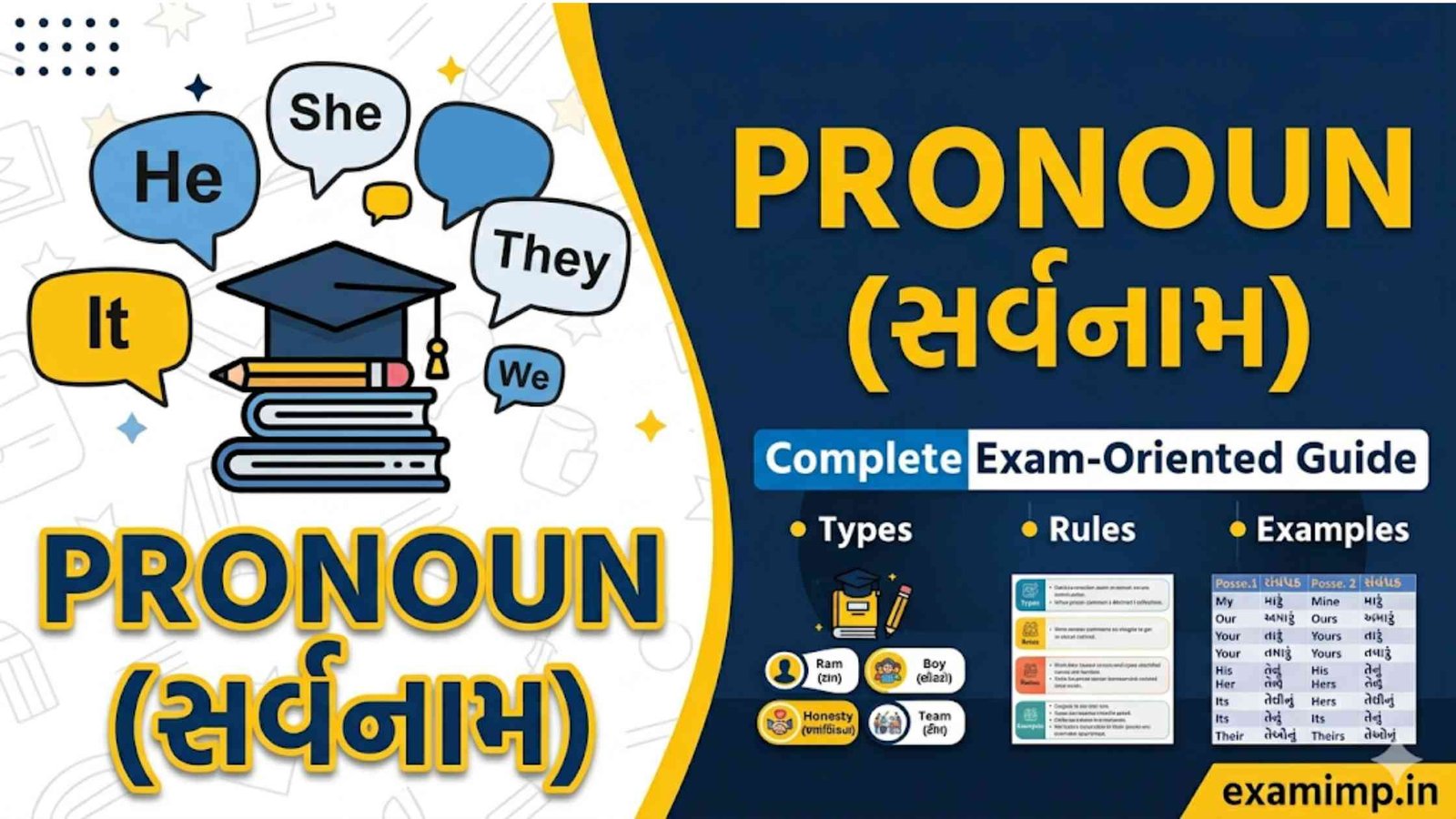
મિત્રો, Pronoun એટલે Noun નું રિપ્લેસમેન્ટ. એટલે કે, જ્યારે એક જ Noun ને વારંવાર બોલવું કે લખવું પડે ત્યારે તેની જગ્યાએ આવતા શબ્દોને Pronoun કહે છે.
ઉદાહરણ:
રમેશ શાળા જાય છે. રમેશ ભણે છે. → બદલો: રમેશ શાળા જાય છે. હ ભણે છે.
UPSC, GPSC, SSC, PSI, Talati, Clerk, DySO જેવી બધી પરીક્ષાઓમાં Pronoun based errors:
- Error Detection
- Sentence Improvement
- Fill in the Blanks
- Spotting Errors
માં આવે છે. આજે આપણે Pronoun ના દરેક પ્રકાર, તેના નિયમો, સામાન્ય ભૂલો અને ટ્રિક્સ આવરી લઈશું.
1. What is Pronoun? – Definition
English: A pronoun is a word that replaces a noun to avoid repetition.
Gujarati: વ્યક્તિ, સ્થળ, પ્રાણી કે વસ્તુના નામની પુનરાવૃત્તિ ટાળવા માટે આવતા શબ્દો.
Example:
Sita is smart. She reads daily. (She = Sita)
2. Types of Pronoun (સંપૂર્ણ યાદી)
| # | Type (Gujarati) | English Name | Examples |
| 1 | પુરુષવાચક | Personal Pronoun | I, we, you, he, she, it, they |
| 2 | પરસ્પરવાચક | Reciprocal Pronoun | each other, one another |
| 3 | પ્રશ્નાર્થક | Interrogative Pronoun | who, whom, whose, which, what |
| 4 | સંબંધવાચક | Relative Pronoun | who, whom, which, that, whose |
| 5 | અનિશ્ચિત | Indefinite Pronoun | somebody, anyone, nothing, all |
| 6 | નિશ્ચયવાચક | Demonstrative Pronoun | this, that, these, those |
| 7 | પોતાવાચક | Reflexive Pronoun | myself, yourself, himself |
| 8 | પોતાના માટે | Emphatic Pronoun | myself, himself (for emphasis) |
| 9 | સ્વામિત્વવાચક | Possessive Pronoun | mine, yours, his, hers, ours |
3. Detailed Study of Each Type with Rules & Errors
3.1 Personal Pronoun (પુરુષવાચક)
Definition: જે વ્યક્તિ કે વસ્તુનો ઉલ્લેખ કરે.
Person-wise Table:
| Person | Singular | Plural |
| First Person (વક્તા) | I, me | we, us |
| Second Person (શ્રોતા) | you | you |
| Third Person (અન્ય) | he, him, she, her, it | they, them |
Rule 1: Order of Personal Pronouns (ક્રમનો નિયમ)
English: 231 (Second, Third, First) for positive; 123 for negative/confession.
Examples:
- ✅ You, he and I are friends. (231)
- ❌ I, you and he are friends.
In fault/negative:
- ✅ I, you and he are responsible. (123)
Rule 2: ‘It’ as dummy subject
- ✅ It is raining.
- ✅ It is difficult to pass this exam.
Common Mistakes:
❌ Me and Ramesh went to market.
✅ Ramesh and I went to market.
❌ Her is a teacher.
✅ She is a teacher.
3.2 Reciprocal Pronoun (પરસ્પરવાચક)
| each other | two persons |
| one another | more than two |
✅ The two brothers love each other.
✅ The ten students helped one another.
Common Mistake:
❌ The two friends helped one another.
✅ The two friends helped each other.
3.3 Interrogative Pronoun (પ્રશ્નાર્થક)
| who | subject (person) |
| whom | object (person) |
| whose | possession |
| which | choice (person/thing) |
| what | thing (no choice) |
✅Who is coming? (subject)
✅ Whom did you meet? (object)
✅ Which is your pen? (choice)
✅ What is your name? (no choice)
Common Mistake:
❌ Whom is there?
✅ Who is there?
3.4 Relative Pronoun (સંબંધવાચક)
Definition: જે pronoun clause ને connect કરે અને તેનો આધાર કોઈ Noun (antecedent) પર હોય.
| Pronoun | Antecedent |
| who | person (subject) |
| whom | person (object) |
| whose | possession |
| which | thing |
| that | person/thing (restrictive) |
Important Rule: ‘That’ vs ‘Which’
- That → essential information (no comma)
- Which → extra information (comma)
✅ This is the book that I bought. (essential)
✅ This book, which is old, is mine. (extra)
Common Mistake:
❌ The man which came here is my uncle.
✅ The man who came here is my uncle.3.5 Indefinite Pronoun (અનિશ્ચિત)
| Singular | Plural | Both |
| anybody, someone, nobody, each, either, neither | both, few, many, several | all, some, none, any |
Rule: Singular indefinite pronouns → singular verb
✅ Everyone has his own choice. (Not ‘their’)
Rule: ‘None’ can be singular/plural
✅ None is perfect. / None are ready.
3.6 Demonstrative Pronoun (નિશ્ચયવાચક)
| Near | Far |
| this (singular) | that (singular) |
| these (plural) | those (plural) |
✅ This is my pen.
✅ Those are my books.
3.7 Reflexive & Emphatic Pronoun
Reflexive: action comes back to subject
✅ He cut himself.
Emphatic: for emphasis only
✅ I myself did it.
| Subject | Reflexive/Emphatic |
| I | myself |
| You | yourself/yourselves |
| He | himself |
| She | herself |
| It | itself |
| We | ourselves |
| They | themselves |
Common Mistake:
❌ Myself went to market.
✅ I myself went to market.
3.8 Possessive Pronoun (સ્વામિત્વવાચક)
| Possessive Adj (Noun સાથે) | Possessive Pronoun (એકલું) |
| my | mine |
| your | yours |
| his | his |
| her | hers |
| our | ours |
| their | theirs |
✅ This book is mine. (not ‘my’)
✅ That car is yours.
4. Important Pronoun Rules for Exams (Micro Concepts)
Rule 1: ‘Let’ પછી Objective Case (me, him, her, us, them)
✅ Let him go. (Not ‘he’)
Rule 2: Than/As પછી subject/object ambiguity
✅ He is taller than I (am).
✅ She loves you more than me (loves me).
Rule 3: Who vs Whom – Replace with he/him trick
- Who = he (subject)
- Whom = him (object)
✅ Who called? → He called.
✅ Whom did you see? → I saw him.
Rule 4: Each/Every/Either/Neither + Singular pronoun
✅ Every student must bring his book.
Rule 5: Nobody/None/No one + singular (formal), plural (informal)
Rule 6: One must be followed by one’s/oneself (not his)
✅ One must love one’s country.
5. Exam Tips (Tricks to Solve Fast)
| Trap | Solution |
| “Me and Ram” | Always “Ram and I” (subject) |
| “Everyone… their” | “Everyone… his” (singular) |
| “Who/Whom confusion” | Replace with he/him |
| “Myself went” | Wrong – use “I myself” |
| “Let I go” | “Let me go” |
| “Between you and I” | “Between you and me” |
| “Each other vs one another” | 2 → each other; 3+ → one another |
6. Previous Year Question Pattern Insight
| SSC CGL | Error: who/whom | Medium | High |
| GPSC Class 1-2 | Pronoun case (me vs I) | Medium | High |
| Talati | Fill: each other/one another | Easy | Medium |
| UPSC CAPF | Relative pronoun (that/which) | Hard | Low-Medium |
| Clerk | Possessive pronoun vs adjective | Easy | Medium |
Most Repeated: Everyone + their (error), Let + me/him, Between you and me
7. 30 MCQs for Practice
Q1. Fill in: ______ is a good teacher.
A) Him B) Her C) He D) His
Q2. Find error: Me and my friend went to cinema.
A) Me B) and C) my friend D) went
Q3. The two sisters love ______.
A) each other B) one another C) themselves D) ourselves
Q4. ______ did you invite to the party?
A) Who B) Whom C) Whose D) Which
Q5. Everyone must bring ______ book.
A) their B) his C) one’s D) her
Q6. This is the boy ______ stole my pen.
A) whom B) which C) who D) whose
Q7. Let ______ go there.
A) he B) him C) his D) himself
Q8. Between you and ______, I am tired.
A) I B) me C) myself D) mine
Q9. One should love ______ country.
A) his B) her C) one’s D) their
Q10. ______ is your name?
A) Who B) Whom C) What D) Which
Q11. The dog hurt ______.
A) itself B) himself C) herself D) myself
Q12. Find error: The man whom came here is my uncle.
A) The man B) whom C) came D) my uncle
Q13. ______ of the two girls is intelligent.
A) Each B) Every C) Both D) Many
Q14. The students helped ______ in the project.
A) each other B) one another C) themselves D) ourselves
Q15. I ______ did the entire work.
A) me B) myself C) mine D) my
Q16. This house is ______.
A) my B) mine C) our D) your
Q17. Find error: She is taller than me.
A) She B) is C) taller D) me
Q18. ______ is knocking at the door?
A) Whom B) Who C) Whose D) Which
Q19. Neither of the boys has done ______ homework.
A) his B) their C) one’s D) her
Q20. The book, ______ is on the table, is mine.
A) that B) which C) who D) whom
Q21. He is the person ______ I trust.
A) who B) whom C) whose D) which
Q22. Let you and ______ try again.
A) I B) me C) myself D) mine
Q23. All is well that ends well. Here ‘all’ is:
A) Personal B) Indefinite C) Relative D) Demonstrative
Q24. ______ did you meet yesterday?
A) Who B) Whom C) Whose D) Which
Q25. Each of the students ______ given a prize.
A) were B) have C) was D) are
Q26. Find error: I and he are best friends.
A) I B) he C) are D) best friends
Q27. ______ book is this?
A) Who B) Whom C) Whose D) Which
Q28. She hurt ______ while cooking.
A) herself B) herself C) himself D) itself
Q29. The team prided ______ on the victory.
A) itself B) themselves C) ourselves D) himself
Q30. One must do ______ duty.
A) his B) one’s C) their D) her
8. Answer Key with Explanations
| 1 | C | He = subject pronoun |
| 2 | A | Correct: My friend and I |
| 3 | A | Two persons → each other |
| 4 | B | ‘did invite’ → object → whom |
| 5 | B | Everyone singular → his |
| 6 | C | stole = verb → subject → who |
| 7 | B | Let + objective case (him) |
| 8 | B | Between + me (object) |
| 9 | C | One → one’s |
| 10 | C | What is your name? |
| 11 | A | It → itself |
| 12 | B | whom → who (subject) |
| 13 | A | Each of the two |
| 14 | B | More than two → one another |
| 15 | B | Emphatic → myself |
| 16 | B | Possessive pronoun → mine |
| 17 | D | than I (am) – subject form |
| 18 | B | Who is knocking? (subject) |
| 19 | A | Neither → singular → his |
| 20 | B | Non-essential → which |
| 21 | B | I trust him → whom |
| 22 | B | Let + me (object) |
| 23 | B | All = indefinite pronoun |
| 24 | B | Whom did you meet? (object) |
| 25 | C | Each + singular verb (was) |
| 26 | A | Correct order: He and I |
| 27 | C | Possession → Whose |
| 28 | A | Reflexive → herself |
| 29 | A | Team as unit → itself |
| 30 | B | One → one’s |
9. Final Memory Shortcuts (ટૂંકમાં યાદ રાખો)
| Subject pronouns | I, we, you, he, she, it, they → Verb પહેલાં |
| Object pronouns | me, us, him, her, it, them → Verb/પ્રેપોઝિશન પછી |
| Let પછી | Object (Let me, him) |
| Between | Object (between you and me) |
| Everyone | Singular (his) |
| One | One’s |
| Who/Whom | Who = he, Whom = him |
| Each other | 2 લોકો |
| One another | 2+ લોકો |
“Pronoun એટલે નાનો શબ્દ પણ મોટી ભૂલનું કારણ. નિયમો યાદ રાખો અને MCQ ફોડો.”
હવે તમે કોઈપણ સ્પર્ધાત્મક પરીક્ષામાં Pronoun ના પ્રશ્નો સરળતાથી ઉકેલી શકશો.