૧. વ્યાખ્યા (Definition)
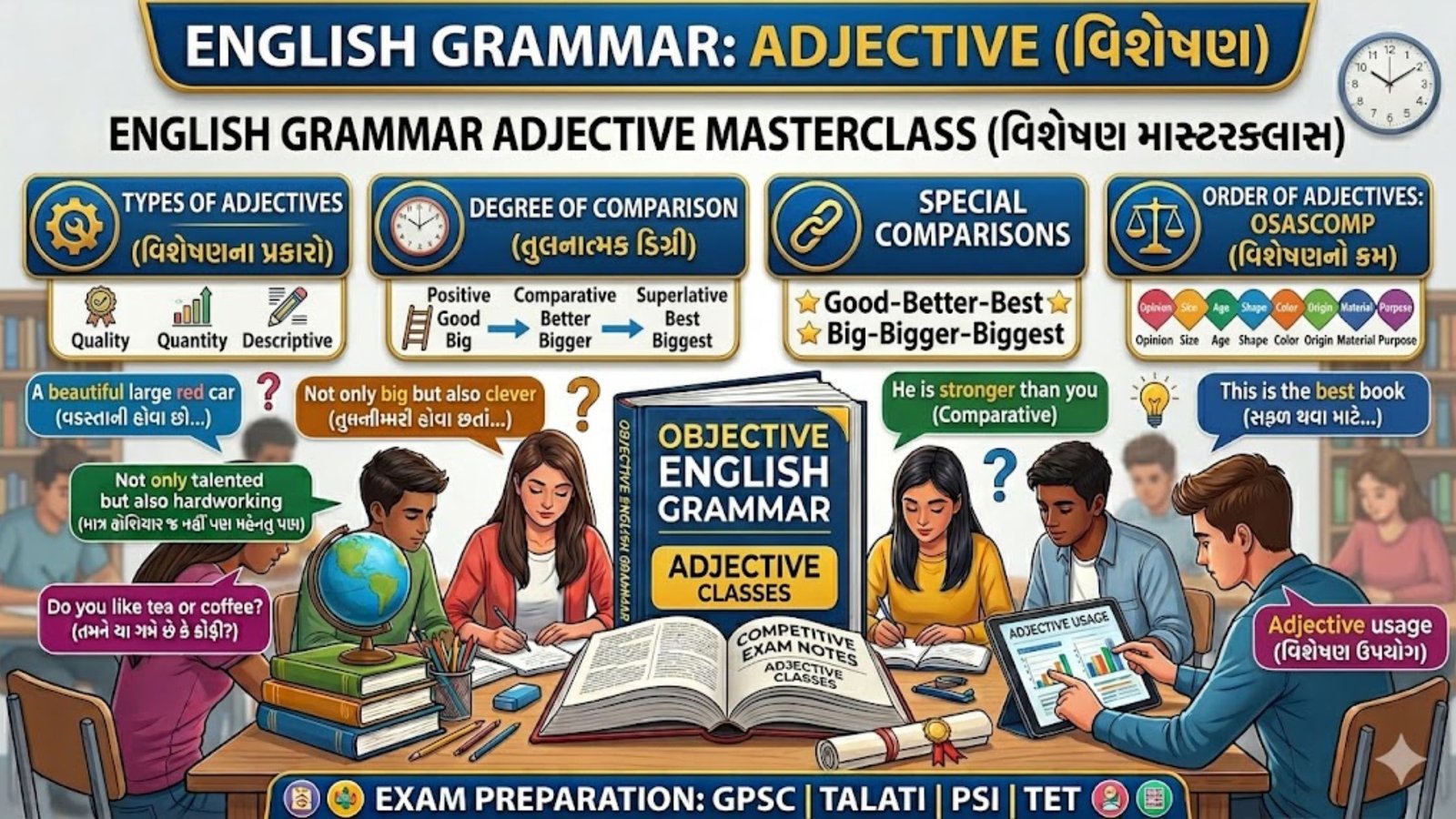
Adjective એ શબ્દ છે જે Noun અથવા Pronoun ની વિશેષતા (ગુણ, દોષ, રંગ, આકાર, કદ, જથ્થો, સંખ્યા) દર્શાવે છે.
પ્રશ્નો: ‘કેવું?’ (What kind?), ‘કેટલું?’ (How much?), ‘કેટલાં?’ (How many?), ‘કયું?’ (Which?)
૨. Adjective ના પ્રકારો (Types of Adjective)
| પ્રકાર | વ્યાખ્યા | ઉદાહરણ |
|---|---|---|
| Adjective of Quality | ગુણ/લક્ષણ | Good, bad, honest, beautiful, tall, short |
| Adjective of Quantity | Uncountable Noun નો જથ્થો | Some, any, much, little, enough, no |
| Adjective of Number | Countable Noun ની સંખ્યા | One, two, first, second, many, several, all, each, every |
| Demonstrative Adjective | ચોક્કસ Noun દર્શાવે | This, that, these, those, such |
| Interrogative Adjective | Noun વિશે પ્રશ્ન | Which, what, whose |
| Possessive Adjective | માલિકી/સંબંધ | My, our, your, his, her, its, their |
| Emphasizing Adjective | ભાર દર્શાવે | Very, own, same |
| Proper Adjective | Proper Noun પરથી | Indian, American, Gujarati |
૩. Degree of Comparison (તુલનાના અંશ) – સૌથી મહત્વનો ભાગ
| Degree | વ્યાખ્યા | ઉદાહરણ |
|---|---|---|
| Positive Degree | કોઈ તુલના વગર | Ram is tall. |
| Comparative Degree | બે વચ્ચે તુલના | Ram is taller than Shyam. |
| Superlative Degree | બધામાં શ્રેષ્ઠ | Ram is the tallest in the class. |
3.1 Rules for making Degrees
| Type | Positive | Comparative | Superlative |
|---|---|---|---|
| 1 syllable | tall, small, big | taller, smaller, bigger (big → bigger – consonant doubled) | tallest, smallest, biggest |
| 1 syllable (e ending) | wise, large | wiser, larger | wisest, largest |
| 2 syllables (y ending) | happy, easy | happier, easier | happiest, easiest |
| 2+ syllables | beautiful, intelligent | more beautiful, more intelligent | most beautiful, most intelligent |
3.2 Irregular Adjectives (અતિ મહત્વ)
| Positive | Comparative | Superlative |
|---|---|---|
| Good / Well | Better | Best |
| Bad / Ill | Worse | Worst |
| Much / Many | More | Most |
| Little (જથ્થો) | Less | Least |
| Little (કદ) | Smaller | Smallest |
| Far (અંતર) | Farther | Farthest |
| Far (વધારે) | Further | Furthest |
| Old (વ્યક્તિ/વસ્તુ) | Older | Oldest |
| Old (કુટુંબ) | Elder | Eldest |
| Late (સમય) | Later | Latest |
| Late (ક્રમ) | Latter | Last |
| Near | Nearer | Nearest / Next |
૪. Degree સંબંધિત 15 મહત્વના નિયમો
Rule 1: Comparative પછી ‘than’
- She is taller than me. (બોલચાલ) / She is taller than I (am). (પરીક્ષા માટે)
Rule 2: Superlative પહેલાં ‘the’ ફરજિયાત
- The best book (સાચું) / He is best (ખોટું)
Rule 3: ‘Than any other’ vs ‘Than any’
- Ram is taller than any other boy in the class. (પોતે સિવાય)
- Ram is taller than any boy. (ખોટું – પોતે પણ સમાવિષ્ટ)
Rule 4: Positive degree માં ‘as…as’ (સકારાત્મક), ‘so…as’ (નકારાત્મક)
- She is as beautiful as her sister.
- He is not so clever as his brother.
Rule 5: Double Comparative ન થાય
- More better (ખોટું) → Better (સાચું)
- Most tallest (ખોટું) → Tallest (સાચું)
Rule 6: Less vs Fewer
- Less → Uncountable (less water, less money)
- Fewer → Countable (fewer books, fewer students)
Rule 7: Elder vs Older
- Elder → Family માટે જ (Elder brother, eldest daughter)
- Older → People/Things બંને (older than me, older building)
Rule 8: Later vs Latter
- Later → Time (Come later)
- Latter → Second of two (Latter half of the year)
Rule 9: Latest vs Last
- Latest → Most recent (latest news)
- Last → Final (last chapter)
Rule 10: Farther vs Further
- Farther → Physical distance (farther from home)
- Further → Abstract/Additional (further information, further study)
Rule 11: Absolute Adjectives (કોઈ Comparison નહિ)
Unique, perfect, complete, universal, excellent, empty, full, impossible, immortal, dead, alive – આના Comparative/Superlative ન થાય.
- This is unique (not ‘more unique’ or ‘most unique’)
Rule 12: Two qualities of same person – ‘more’ + Positive
- He is more clever than honest. (સાચું)
- He is cleverer than honest. (ખોટું – બે અલગ qualities)
Rule 13: ‘The…the’ structure (Double Comparative)
- The more you study, the better marks you get.
Rule 14: Preferable/Prior/Superior/Inferior/Junior/Senior → to (than નહિ)
- He is superior to me. (superior than – ખોટું)
- This is preferable to that.
Rule 15: One of the + Superlative + Plural Noun
- He is one of the best boys in the class. (boy – singular? No, boys – plural)
૫. Adjective નો ક્રમ (Order of Adjectives) – OSASCOMP
| Order | Category | Examples |
|---|---|---|
| O = Opinion | અભિપ્રાય | beautiful, ugly, nice |
| S = Size | કદ | big, small, tall |
| A = Age | ઉંમર | old, new, young |
| S = Shape | આકાર | round, square, flat |
| C = Color | રંગ | red, blue, black |
| O = Origin | મૂળ | Indian, Chinese, American |
| M = Material | સામગ્રી | wooden, plastic, gold |
| P = Purpose | હેતુ | dining (table), swimming (pool) |
ઉદાહરણ: A beautiful (O) small (S) old (A) round (S) red (C) Chinese (O) wooden (M) dining (P) table ✓
૬. Some/Any, Few/Little, Each/Every, Either/Neither – મહત્વના તફાવત
| Some | Any | |
|---|---|---|
| Positive sentence | I have some money. | – |
| Negative sentence | – | I don’t have any money. |
| Question (general) | – | Do you have any money? |
| Question (offer/request) | Would you like some tea? | – |
| Few | A few | The few | |
|---|---|---|---|
| Meaning | ઓછા (નકારાત્મક) | થોડા (સકારાત્મક) | જેટલા ઓછા છે તે |
| Example | Few people came. (ઓછા આવ્યા) | A few people came. (થોડા આવ્યા) | The few friends he has are loyal. |
| Little | A little | The little | |
|---|---|---|---|
| Meaning | ઓછું (નકારાત્મક) | થોડું (સકારાત્મક) | જેટલું ઓછું છે તે |
| Example | Little water is left. (ઓછું) | A little water is left. (થોડું) | The little money he had was stolen. |
| Each | Every | |
|---|---|---|
| Use | બે કે તેથી વધુ (વ્યક્તિગત) | ત્રણ કે તેથી વધુ (સમૂહ) |
| Verb | Singular | Singular |
| Example | Each boy is ready. | Every student was present. |
| Either | Neither | |
|---|---|---|
| Meaning | બેમાંથી કોઈ એક (સકારાત્મક) | બેમાંથી કોઈ નહિ (નકારાત્મક) |
| Verb | Singular | Singular |
| Example | Either of the two is fine. | Neither of them came. |
૭. Adjectives ને બદલે Adverbs નો ખોટો ઉપયોગ (Common Errors)
| ખોટું | સાચું | નિયમ |
|---|---|---|
| She sings beautiful. | She sings beautifully. | Verb પછી Adverb |
| He is extreme clever. | He is extremely clever. | Adjective પહેલાં Adverb |
| I feel badly. | I feel bad. | Feel/Smell/Taste/Look/Seem/Be – Linking verbs પછી Adjective |
૮. ભૂતકાળના પરીક્ષા પ્રશ્નો (Past Exam Questions)
Type 1: Degree of Comparison
પ્રશ્ન: This is the ______ book I have ever read.
- (A) good (B) better (C) best (D) more good
જવાબ: (C) best
(GSSSB Talati, 2016)
Type 2: Comparative
પ્રશ્ન: She is ______ than her sister.
- (A) tall (B) taller (C) tallest (D) more tall
જવાબ: (B) taller
(Gujarat Police Constable, 2018)
Type 3: Less vs Fewer
પ્રશ્ન: There are ______ students in class today.
- (A) less (B) fewer (C) lesser (D) few
જવાબ: (B) fewer
(TET-1, 2019)
Type 4: Elder vs Older
પ્રશ્ન: My ______ brother is a doctor.
- (A) older (B) elder (C) oldest (D) eldest
જવાબ: (B) elder
(Bin Sachivalay Clerk, 2017)
Type 5: As…as / So…as
પ્રશ્ન: He is not ______ tall as his father.
- (A) as (B) so (C) more (D) very
જવાબ: (B) so
(GPSC Class 3, 2015)
Type 6: Order of Adjectives
પ્રશ્ન: Choose the correct order:
- (A) A red big ball (B) A big red ball (C) A ball red big (D) Red big a ball
જવાબ: (B) A big red ball
(Gujarat High Court Clerk, 2020)
Type 7: Absolute Adjective
પ્રશ્ન: Which sentence is correct?
- (A) This is the most unique painting. (B) This is a unique painting. (C) This is more unique. (D) This is uniquest.
જવાબ: (B) This is a unique painting.
(TAT Secondary, 2017)
Type 8: Double Comparative
પ્રશ્ન: ______ you practice, ______ you become.
- (A) More, better (B) The more, the better (C) Much, good (D) Many, best
જવાબ: (B) The more, the better
(PSI Exam, 2019)
Type 9: Some vs Any
પ્રશ્ન: I have ______ important work to do.
- (A) any (B) some (C) no any (D) a
જવાબ: (B) some
(Gujarat Panchayat Service, 2016)
Type 10: Each/Every
પ્રશ્ન: Every student ______ a uniform.
- (A) wear (B) wears (C) wearing (D) have worn
જવાબ: (B) wears
(Talati cum Mantri, 2018)
Type 11: Error Spotting
પ્રશ્ન: She is (A)/ more taller than (B)/ her friend. (C)/ No error (D)
જવાબ: (B) more taller → taller
(GSSSB Clerk, 2014)
Type 12: Interrogative Adjective
પ્રશ્ન: ______ book is this?
- (A) Who (B) Whom (C) Whose (D) Which
જવાબ: (C) Whose
(Gujarat Constable, 2015)
Type 13: Superlative with ‘one of the’
પ્રશ્ન: He is one of the ______ boys in the class.
- (A) best (B) better (C) good (D) more good
જવાબ: (A) best (Note: boys – plural)
(Bin Sachivalay, 2019)
Type 14: Many vs Much
પ્રશ્ન: How ______ money do you need?
- (A) many (B) much (C) more (D) most
જવાબ: (B) much
(TET-2, 2018)
Type 15: Either/Neither
પ્રશ્ન: ______ of the two answers is correct.
- (A) Both (B) Either (C) Some (D) Many
જવાબ: (B) Either
(GPSC Class 1-2, 2017)
૯. પરીક્ષા ઉપયોગી ટીપ્સ (Exam Tips)
- Comparative → ‘than’ (taller than)
- Superlative → ‘the’ (the tallest)
- Elder/Eldest → Family only (Elder brother, eldest daughter)
- Older/Oldest → People & things (older than me, oldest building)
- Less = Uncountable, Fewer = Countable
- Later = Time, Latter = Second of two
- Latest = Most recent, Last = Final
- Farther = Distance, Further = Additional
- Each (individual), Every (group) – both singular verb
- Some = positive, Any = negative/question
- A few (positive), Few (negative), The few (limited)
- A little (positive), Little (negative), The little (limited)
- Unique/Perfect/Complete – no comparison
- Superior/Inferior/Junior/Senior/Preferable/Prior → to
- One of the + Superlative + Plural Noun (one of the best students)
૧૦. Quick Revision Table
| Category | Positive | Comparative | Superlative |
|---|---|---|---|
| 1-syllable | tall | taller | tallest |
| 2-syllable (y) | happy | happier | happiest |
| 2+ syllable | beautiful | more beautiful | most beautiful |
| Irregular | good | better | best |
| Irregular | bad | worse | worst |
| Irregular | much/many | more | most |
| Irregular | little (quantity) | less | least |
| Family | – | elder | eldest |
| Distance | far | farther | farthest |
| Abstract | far | further | furthest |
૧૧. અભ્યાસ માટે 30 ટેસ્ટ પ્રશ્નો (Self-Assessment)
- This is the ______ (good) movie I have ever seen.
- He is ______ (tall) than his brother.
- She is ______ (intelligent) than her cousin.
- No other student is as ______ (brilliant) as Raj.
- Mount Everest is the ______ (high) peak.
- Prevention is ______ (good) than cure.
- I have ______ (less/fewer) friends than you.
- There is ______ (less/fewer) water in the glass.
- She is ______ (elder/older) than her husband.
- He is my ______ (elder/older) brother.
- He is ______ (the best/best) player.
- This is a ______ (unique/most unique) design.
- ______ (The more/More) you eat, ______ (the fatter/fatter) you become.
- He has ______ (some/any) money.
- Does he have ______ (some/any) friends?
- ______ students passed. (Few/A few – meaning થોડા સકારાત્મક)
- ______ water is left. (Little/A little – meaning થોડું સકારાત્મક)
- ______ boy was given a prize. (Each/Every – two boys)
- ______ of the two books is good. (Either/Neither)
- He is superior ______ me. (to/than)
- Correct order: ______ (a small red plastic bag / a red small plastic bag)
- Correct order: ______ (an old beautiful house / a beautiful old house)
- He is more taller than me. (Correct/Incorrect)
- She is the best of the two. (Correct/Incorrect)
- She is more clever than her sister. (Correct/Incorrect)
- He gave me an useful advice. (Correct/Incorrect)
- Red rose – type of adjective: ______
- Five books – type: ______
- Much water – type: ______
- Whose pen – type: ______
જવાબો:
1 best, 2 taller, 3 more intelligent, 4 brilliant, 5 highest, 6 better, 7 fewer, 8 less, 9 older, 10 elder, 11 the best, 12 unique, 13 The more – the fatter, 14 some, 15 any, 16 A few, 17 A little, 18 Each (if two), 19 Either, 20 to, 21 a small red plastic bag, 22 a beautiful old house, 23 Incorrect (taller), 24 Incorrect (better of the two), 25 Correct, 26 Incorrect (a useful), 27 Quality, 28 Number, 29 Quantity, 30 Interrogative