
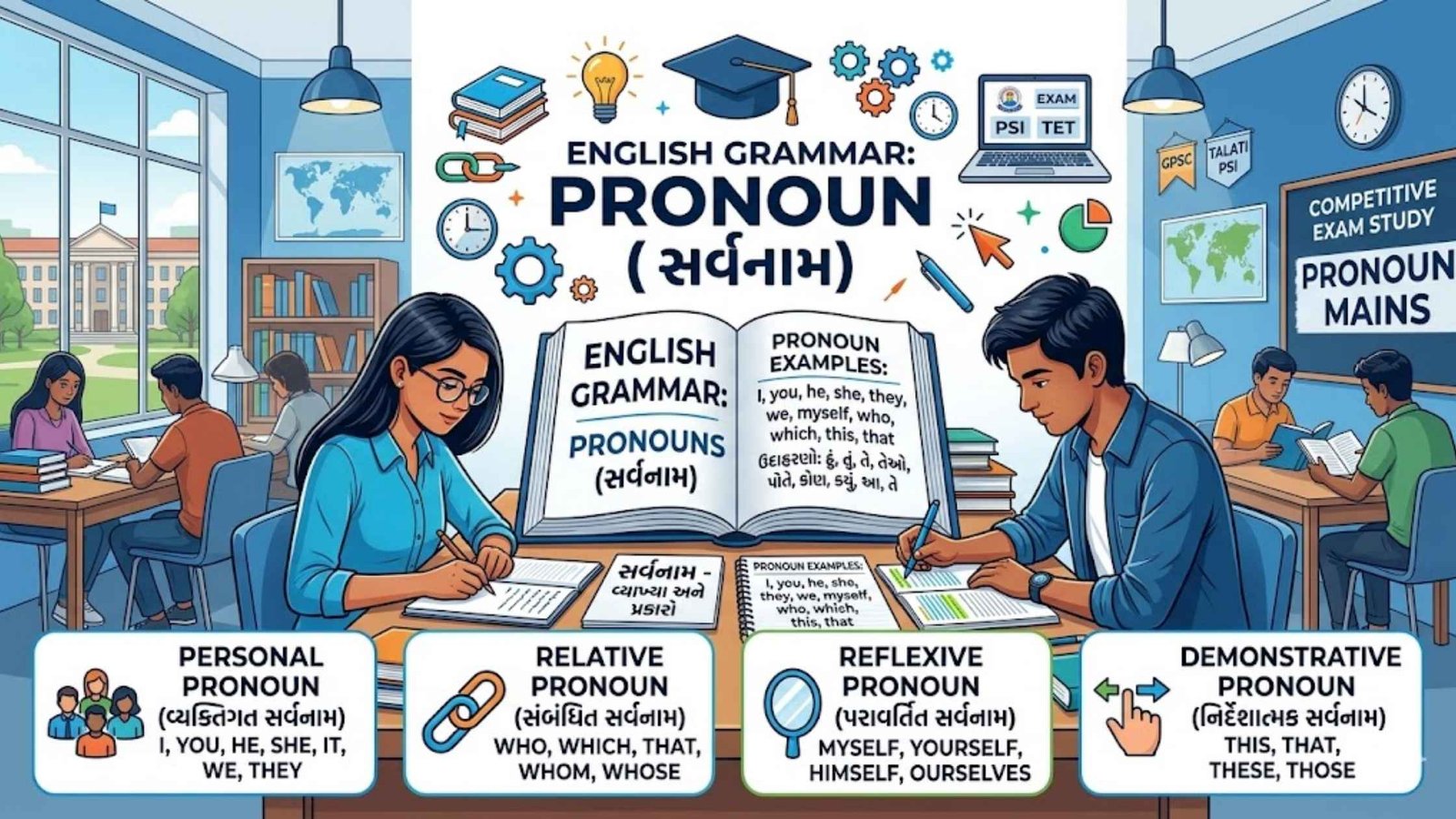
૧. વ્યાખ્યા (Definition)
Pronoun એ શબ્દ છે જે Noun ના બદલે વપરાય છે. તે વાક્યમાં પુનરાવર્તન ટાળવા માટે ઉપયોગી છે.
ઉદાહરણ:
- રમિત છોકરો છે. He સારો છે. (રમિત ને બદલે He)
- સીતા અને ગીતા આવી. They વાંચે છે.
૨. Pronoun ના પ્રકારો (Types of Pronoun)
સ્પર્ધાત્મક પરીક્ષા માટે નીચેના 8 પ્રકારો ખૂબ જ મહત્વના છે.
| પ્રકાર | વ્યાખ્યા | ઉદાહરણ |
|---|---|---|
| Personal Pronoun | વ્યક્તિ (હું, તું, તે, અમે, તમે, તેઓ) | I, We, You, He, She, It, They |
| Possessive Pronoun | માલિકી/સંબંધ દર્શાવે | Mine, Ours, Yours, His, Hers, Its, Theirs |
| Reflexive Pronoun | ક્રિયા કર્તા પર જ પાછી આવે (પોતે) | Myself, Yourself, Himself, Herself, Itself, Ourselves, Themselves |
| Demonstrative Pronoun | ચોક્કસ વ્યક્તિ/વસ્તુ દર્શાવે | This, That, These, Those |
| Interrogative Pronoun | પ્રશ્ન પૂછવા માટે | Who, Whom, Whose, Which, What |
| Relative Pronoun | બે વાક્યોને જોડે (Antecedent સાથે સંબંધ) | Who, Whom, Whose, Which, That |
| Indefinite Pronoun | અનિશ્ચિત વ્યક્તિ/વસ્તુ | Somebody, Anyone, Nothing, Few, Many, Several |
| Distributive Pronoun | એક સમયે એક જ વ્યક્તિ/વસ્તુ | Each, Either, Neither |
૩. Personal Pronoun ના Cases (રૂપો)
આ ખૂબ મહત્વનું છે કારણ કે પરીક્ષામાં ખોટા Case નો ઉપયોગ પૂછાય છે.
| Person | Subjective Case (કર્તા) | Objective Case (કર્મ) | Possessive Case (સંબંધ) |
|---|---|---|---|
| First Person Singular | I | Me | My / Mine |
| First Person Plural | We | Us | Our / Ours |
| Second Person S/Pl | You | You | Your / Yours |
| Third Person Sing (M) | He | Him | His / His |
| Third Person Sing (F) | She | Her | Her / Hers |
| Third Person Sing (N) | It | It | Its / Its |
| Third Person Plural | They | Them | Their / Theirs |
૪. પરીક્ષામાં સૌથી વધુ પૂછાતા નિયમો (Important Rules)
Rule 1: Subjective vs Objective Case
- Subjective (I, We, He, She, They, You, It) → ક્રિયાપદ પહેલાં (કર્તા)
- He and I are friends. (યોગ્ય)
- Objective (Me, Us, Him, Her, Them, You, It) → ક્રિયાપદ/પ્રેપોઝિશન પછી (કર્મ)
- Between you and me (સાચું, I નહિ)
- She invited him and me. (સાચું)
ભૂલ: He sat between Rohan and I. → સાચું: He sat between Rohan and me.
Rule 2: Reflexive Pronoun નો ઉપયોગ
જ્યારે કર્તા અને કર્મ સમાન હોય ત્યારે Reflexive આવે.
- I hurt myself. (સાચું)
- You should blame yourself. (સાચું)
ખોટો ઉપયોગ: Myself will go there. → સાચું: I myself will go there. અથવા I will go there.
Rule 3: Relative Pronoun Who/Whom/Which/That
| Pronoun | ક્યારે વાપરવું | ઉદાહરણ |
|---|---|---|
| Who | વ્યક્તિ માટે (Subjective) | The man who came here is my uncle. |
| Whom | વ્યક્તિ માટે (Objective) | The man whom I met is kind. |
| Which | પ્રાણી/વસ્તુ માટે | The book which is on the table is red. |
| That | વ્યક્તિ/પ્રાણી/વસ્તુ (બધા માટે) | This is the car that I bought. |
| Whose | સંબંધ/માલિકી માટે | The boy whose father is a doctor is my friend. |
નોંધ: અતિરિક્ત માહિતી માટે Comma પછી Who/Which; That નો ઉપયોગ Comma પછી ન થાય.
Rule 4: Demonstrative Pronoun (This/That/These/Those)
- This/These → નજીકની વસ્તુ
- That/Those → દૂરની વસ્તુ
- It → ચોક્કસ ઓળખ વગર (વરસાદ, સમય, અંતર)
- It is raining. / It is 5 o’clock. / It is 10 km from here.
Rule 5: Indefinite Pronoun અને Verb Agreement
| Pronoun | Verb (Singular/Plural) | ઉદાહરણ |
|---|---|---|
| Everyone, Somebody, Nobody, Each, Either, Neither | Singular | Everybody has come. |
| Few, Many, Several, Both | Plural | Few were present. |
| All, Some, None, Most (જેના આધારે – Countable/Uncountable) | Singular/Plural બંને | All is well. / All are present. |
Rule 6: Distributive Pronoun (Each, Either, Neither)
- Each → બે કે તેથી વધુમાં એક એક
- Either → બેમાંથી કોઈ એક (સકારાત્મક)
- Neither → બેમાંથી કોઈ નહિ (નકારાત્મક)
આ ત્રણેય Singular ગણાય.
- Each of the boys is ready. (are નહિ)
- Neither of the answers is correct. (are નહિ)
Rule 7: Who vs Whom (અતિ મહત્વ)
- Who = He/She (કર્તા)
- Whom = Him/Her (કર્મ)
ટ્રીક:
- Who (He) is calling? → He is calling.
- Whom (Him) did you see? → I saw him.
Rule 8: Pronoun નો Antecedent સાથે સંમતિ (Agreement)
Pronoun તેના Antecedent (જેના બદલે આવ્યો) સાથે Number, Gender, Person માં મેળ ખાય.
- Every student must bring his/her book. (અપવાદ: હવે ‘their’ પણ ચાલે – પરંતુ પરીક્ષામાં ‘his/her’ સુરક્ષિત)
- Neither Rohan nor Sohan completed his work. (બંને પુરુષ)
- Neither the teacher nor the students finished their work. (છેલ્લો Antecedent plural → their)
Rule 9: Let પછી Objective Case
- Let me go. (I નહિ)
- Let him and her sit. (he/she નહિ)
૫. Pronoun સંબંધિત સામાન્ય ભૂલો (Common Errors)
| ખોટું વાક્ય | સાચું વાક્ય | સમજૂતી |
|---|---|---|
| Myself went to market. | I myself went to market. | Reflexive pronoun એકલો કર્તા ન બની શકે. |
| Between you and I | Between you and me | Preposition ‘between’ પછી Objective case. |
| Each of them were late. | Each of them was late. | Each → Singular. |
| Who did you meet? | Whom did you meet? | Meet પછી Objective. |
| This is the boy whom works hard. | This is the boy who works hard. | Works = ક્રિયા, કર્તા Who. |
| Everyone should bring their book. | Everyone should bring his/her book. (પરંપરાગત) | Everyone singular. |
| It is me. | It is I. (અતિ ઔપચારિક) / It’s me. (બોલચાલ – પરીક્ષામાં It is I ને પ્રાધાન્ય) | To be પછી Subjective case. |
| Your’s faithfully | Yours faithfully | Possessive pronoun માં apostrophe ન હોય. |
| The dog lost it’s collar. | The dog lost its collar. | It’s = It is/has; Its = Possessive. |
૬. ભૂતકાળના પરીક્ષા પ્રશ્નો (Past Exam Questions)
Type 1: Subjective vs Objective Case
પ્રશ્ન: Choose the correct option: Between you and ______, I don’t trust him.
- (A) I (B) me (C) myself (D) mine
જવાબ: (B) me
(GSSSB Talati, 2016)
Type 2: Reflexive Pronoun
પ્રશ્ન: Fill in the blank: He ______ cleaned the house.
- (A) yourself (B) himself (C) itself (D) her
જવાબ: (B) himself
(Gujarat Police Constable, 2019)
Type 3: Relative Pronoun
પ્રશ્ન: This is the man ______ stole my watch.
- (A) whom (B) which (C) who (D) whose
જવાબ: (C) who
(Bin Sachivalay Clerk, 2018)
પ્રશ્ન: The book, ______ is on the table, is mine.
- (A) who (B) whom (C) which (D) whose
જવાબ: (C) which
(TET-2, 2017)
Type 4: Who vs Whom
પ્રશ્ન: ______ did you invite to the party?
- (A) Who (B) Whom (C) Whose (D) Which
જવાબ: (B) Whom (કારણ: invite પછી કર્મ)
(GPSC Class 3, 2015)
Type 5: Indefinite Pronoun – Verb Agreement
પ્રશ્ન: Everyone in the class ______ submitted the assignment.
- (A) have (B) has (C) are (D) were
જવાબ: (B) has
(Gujarat High Court Clerk, 2020)
Type 6: Distributive Pronoun
પ્રશ્ન: Neither of the two boys ______ guilty.
- (A) are (B) were (C) is (D) have been
જવાબ: (C) is
(TAT Secondary, 2018)
Type 7: Possessive Pronoun
પ્રશ્ન: This house is ______. (We)
- (A) our (B) us (C) ours (D) ourselves
જવાબ: (C) ours
(GSSSB Clerk, 2014)
Type 8: Error Spotting
પ્રશ્ન: Myself and Raju (A)/ went to the market (B)/ to buy vegetables (C)/ No error (D)
જવાબ: (A) → Raju and I myself અથવા Raju and I
(PSI Exam, 2021)
પ્રશ્ન: Each of the girls (A)/ have completed (B)/ their homework (C)/ No error (D)
જવાબ: (B) have → has; (C) their → her (પરંપરાગત)
(Talati cum Mantri, 2019)
Type 9: Let પછી Pronoun
પ્રશ્ન: Let ______ go to the cinema.
- (A) we (B) us (C) our (D) ourselves
જવાબ: (B) us
(Gujarat Panchayat Service, 2017)
Type 10: It vs There (શરૂઆતમાં)
પ્રશ્ન: ______ is a temple near my house.
- (A) It (B) There (C) This (D) That
જવાબ: (B) There
(Bin Sachivalay, 2016)
૭. પરીક્ષા ઉપયોગી ટીપ્સ (Exam Tips)
- Pronoun ની Priority Order (સંયુક્ત કર્તા):
2nd Person (You) → 3rd Person (He/She) → 1st Person (I)
You, he and I are responsible. (યોગ્ય) - Who vs Whom ટ્રીક:
પ્રશ્નના જવાબમાં જો He/She બેસે તો Who, Him/Her બેસે તો Whom. - Reflexive નો ઉપયોગ ભાર માટે (Emphatic):
I myself saw the accident. (Emphatic)
I hurt myself. (Reflexive) - Each other vs One another:
- Each other → બે વ્યક્તિઓ માટે
- One another → બેથી વધુ માટે
- Their vs There vs They’re:
- Their (તેમનું) – Possessive
- There (ત્યાં) – Place
- They’re (તેઓ છે) = They are
- Its vs It’s:
- Its (તેનું) – Possessive (No apostrophe)
- It’s (તે છે/તેની પાસે) = It is / It has
૮. અભ્યાસ માટે 25 ટેસ્ટ પ્રશ્નો (Self-Assessment)
- ______ is a good teacher. (He/Him)
- Please give the book to ______. (I/me)
- ______ did you see at the station? (Who/Whom)
- ______ is your father? (Who/Whom)
- Let ______ do the work. (she/her)
- Everyone should respect ______ parents. (his/her/their)
- Neither of the answers ______ correct. (is/are)
- Few ______ present yesterday. (was/were)
- She cut ______ while cooking. (her/herself)
- ______ of the two dresses is beautiful. (Each/Every)
- Between you and ______, he is wrong. (I/me)
- The students, ______ are on the ground, are playing. (who/whom)
- The boy ______ bag is lost is crying. (whose/whom)
- He is taller than ______. (I/me) – Than પછી Subjective (પૂર્ણ વાક્ય માનો)
- He loves ______ more than me. (his/himself)
- We should blame ______ for the failure. (our/ourselves)
- One should do ______ duty. (one’s/his)
- This pen is ______. (my/mine)
- They completed the work ______. (their/themselves)
- ______ of the two brothers is hardworking. (Either/Neither – સકારાત્મક)
- I saw ______ in the mirror. (me/myself)
- ______ is very hot today. (It/There)
- The committee members quarrelled among ______. (themselves/each other)
- All that glitters ______ not gold. (is/are)
- Ram as well as his friends ______ done ______ work. (has/have; his/their)
જવાબો: 1 He, 2 me, 3 Whom, 4 Who, 5 her, 6 his/her, 7 is, 8 were, 9 herself, 10 Each, 11 me, 12 who, 13 whose, 14 I, 15 himself, 16 ourselves, 17 one’s, 18 mine, 19 themselves, 20 Either, 21 myself, 22 It, 23 themselves, 24 is, 25 has – his
૯. Quick Revision Table (ઝડપી પુનરાવર્તન)
| Pronoun Type | Examples | Key Exam Point |
|---|---|---|
| Personal | I, me, he, him | Between you and me |
| Possessive | mine, yours, hers | No apostrophe: Yours faithfully |
| Reflexive | myself, herself | Cannot be subject alone |
| Relative | who, whom, which | Who (subject), Whom (object) |
| Indefinite | everyone, few | Everyone → Singular verb |
| Distributive | each, either, neither | Each of them is |
| Demonstrative | this, that, these, those | This/These → near |
| Interrogative | who, which, what | Who is calling? |