૧. વ્યાખ્યા (Definition)
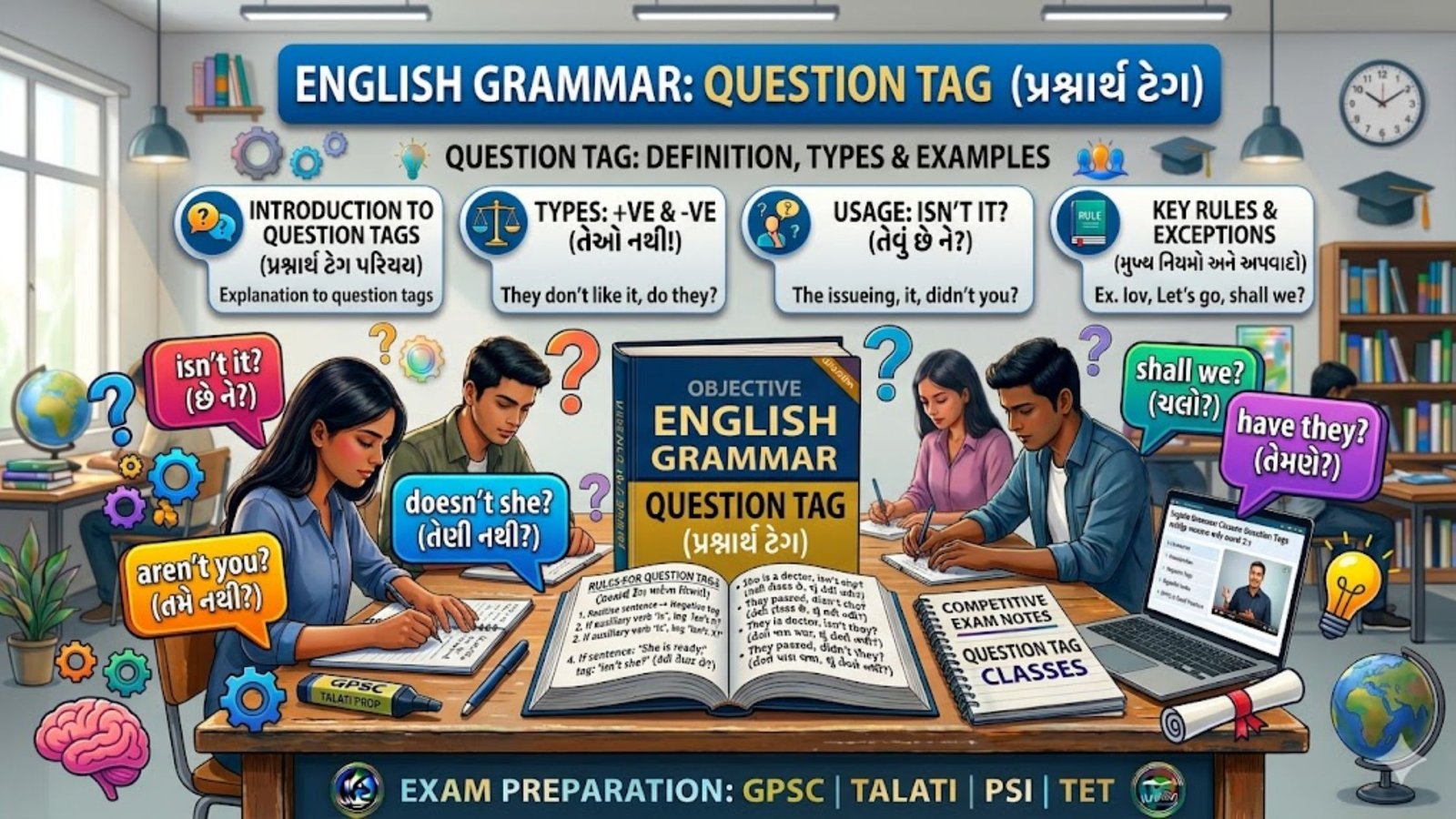
Question-Tag એ વાક્યના અંતે આવતો નાનો પ્રશ્ન છે જે વક્તાની પુષ્ટિની અપેક્ષા દર્શાવે છે. તેનો ઉપયોગ કોઈ વાતની ખાતરી કરવા, સંમતિ મેળવવા અથવા પુષ્ટિ કરવા થાય છે.
બંધારણ (Structure):
Statement (હકીકત વાક્ય) + Comma (,) + Auxiliary Verb + Pronoun + Question Mark (?)
ઉદાહરણ:
- You are a student, aren’t you?
- She sings well, doesn’t she?
- He has gone, hasn’t he?
૨. Question-Tag ના સુવર્ણ નિયમો (Golden Rules)
Rule 1: Positive Statement → Negative Tag
જો વાક્ય સકારાત્મક (Positive) હોય તો ટૅગ નકારાત્મક (Negative) આવે.
- *He is honest, isn’t he? * ✓
- *They work hard, don’t they? *
Rule 2: Negative Statement → Positive Tag
જો વાક્ય નકારાત્મક (Negative) હોય તો ટૅગ સકારાત્મક (Positive) આવે.
- *He is not honest, is he? *
- *They do not work hard, do they? *
Rule 3: Auxiliary Verb નો ઉપયોગ
ટૅગમાં વાક્યના Auxiliary Verb (is, am, are, was, were, do, does, did, has, have, had, will, would, shall, should, can, could, may, might, must) નો જ ઉપયોગ થાય.
Auxiliary ન હોય ત્યારે:
- Simple Present Tense (સકારાત્મક) → do/does
- *You like coffee, don’t you? *
- *She plays tennis, doesn’t she? *
- Simple Past Tense (સકારાત્મક) → did
- *They came late, didn’t they? *
Rule 4: Pronoun નો ઉપયોગ
ટૅગમાં વાક્યના કર્તા (Subject) ના બદલે તેનો Pronoun આવે.
- *Ram is clever, isn’t he? * (Ram → he)
- *Sita and Geeta are sisters, aren’t they? *
- *The book is on the table, isn’t it? *
Rule 5: Tag નો સ્વર (Intonation)
- Rising tone (↗) → વાસ્તવિક પ્રશ્ન, ઉત્તર અજાણ્યો
- Falling tone (↘) → પુષ્ટિની અપેક્ષા (મોટા ભાગની પરીક્ષામાં આની જરૂર નથી, પણ સમજ માટે ઉપયોગી)
૩. વિશેષ નિયમો (Special Rules) – પરીક્ષા માટે અતિ મહત્વના
Rule A: I am → aren’t I?
I am નો નકારાત્મક ટૅગ aren’t I? થાય. (amn’t I નો ઉપયોગ થતો નથી)
- *I am clever, aren’t I? * ✓
- *I am not late, am I? *
Rule B: Let’s → shall we?
Let’s (Let us) નો ટૅગ shall we? થાય.
- *Let’s go for a walk, shall we? *
- *Let’s start the meeting, shall we? *
Rule C: Imperative Sentence (આજ્ઞાર્થ વાક્ય)
આજ્ઞા, વિનંતી, સલાહ માટે:
- Open the door, will you? / won’t you? (will you વધુ સામાન્ય)
- Don’t make noise, will you? (નકારાત્મક આજ્ઞા → will you?)
- Sit down, won’t you? (નમ્ર વિનંતી)
અપવાદ: *Please help me, will you? *
Rule D: Nobody/No one/Somebody/Everyone/Anyone
આ Indefinite Pronouns Singular છે. ટૅગમાં they આવે.
- *Nobody came, did they? * (he નહિ)
- *Everyone is here, aren’t they? * (isn’t he નહિ)
- *Somebody has called, haven’t they? *
Rule E: Nothing/Everything/Something
આ અનિશ્ચિત વસ્તુઓ → ટૅગમાં it.
- *Nothing is impossible, is it? *
- *Everything looks fine, doesn’t it? *
Rule F: There is/are/was/were
‘There’ થી શરૂ થતાં વાક્યોમાં ટૅગમાં there જ રહે.
- *There is a temple, isn’t there? *
- *There were many people, weren’t there? *
Rule G: Hardly, Scarcely, Barely, Rarely, Never, No, None, Neither
આ નકારાત્મક (Negative) શબ્દોવાળું વાક્ય → Positive Tag.
- *He hardly works, does he? * (doesn’t he નહિ)
- *She never tells a lie, does she? *
- *None of them came, did they? *
Rule H: Must
- Must (ફરજ/શક્યતા) → mustn’t? (નકાર) / needn’t? (જરૂર નથી)
- *You must go, mustn’t you? *
- *You must not smoke, must you? *
- Must (નિષ્કર્ષ/ચોક્કસતા – He must be tired) → isn’t he? / aren’t they? (Must ને બદલે યોગ્ય Auxiliary)
- *He must be sleeping, isn’t he? * (mustn’t he નહિ)
Rule I: Used to → didn’t?
- *He used to play cricket, didn’t he? * (usedn’t he પણ ભાગ્યે જ)
- *She used to be late, didn’t she? *
Rule J: Ought to → oughtn’t?
- *We ought to respect elders, oughtn’t we? *
Rule K: Need/Dare
- *He need not go, need he? * (need as modal)
- *He dare not speak, dare he? *
- *He needs help, doesn’t he? * (need as main verb)
Rule L: Have/Has/Had
- Have/Has/Had + V3 (Perfect Tense) → haven’t/hasn’t/hadn’t
- *She has finished, hasn’t she? *
- Have/Has/Had (Possession) → do/does/did
- *You have a car, don’t you? * (haven’t you? પણ British English માં ચાલે, પણ પરીક્ષામાં don’t you? ને વધુ પ્રાધાન્ય)
- Had better → hadn’t?
- *You had better leave, hadn’t you? *
૪. Question-Tag બનાવવાની Step-by-Step પ્રક્રિયા
| Step | ક્રિયા | ઉદાહરણ |
|---|---|---|
| 1 | Statement ઓળખો: Positive (+) કે Negative (-) | She is a doctor. (+) |
| 2 | Auxiliary Verb શોધો (ન હોય તો do/does/did લાવો) | is |
| 3 | Auxiliary નો વિરોધી સ્વરૂપ બનાવો (+ → – ; – → +) | is → isn’t |
| 4 | Subject નો Pronoun શોધો | She → she |
| 5 | Tag બનાવો: Aux + Pronoun + ? | isn’t she? |
| 6 | Final Sentence: She is a doctor, isn’t she? | ✓ |
૫. સામાન્ય ભૂલો અને તેમના સુધારા (Common Errors)
| ખોટું Tag | સાચું Tag | નિયમ |
|---|---|---|
| I am happy, amn’t I? | I am happy, aren’t I? | amn’t નો ઉપયોગ નથી |
| Let’s dance, don’t we? | Let’s dance, shall we? | Let’s → shall we |
| Nobody knows, doesn’t he? | Nobody knows, do they? | Nobody = singular → they |
| Everything is fine, aren’t they? | Everything is fine, isn’t it? | Everything → it |
| There is a cat, isn’t it? | There is a cat, isn’t there? | There + be → there in tag |
| He hardly comes, doesn’t he? | He hardly comes, does he? | Hardly = negative → positive tag |
| He used to smoke, usedn’t he? | He used to smoke, didn’t he? | used to → didn’t |
| Close the door, don’t you? | Close the door, will you? | Imperative → will you |
| She has a pen, hasn’t she? | She has a pen, doesn’t she? | Possession → do/does (પરીક્ષા માટે) |
| You must go, mustn’t you? | You must go, mustn’t you? (આ ચાલે છે) | No error (mustn’t you is fine) |
૬. ભૂતકાળના પરીક્ષા પ્રશ્નો (Past Exam Questions)
Type 1: Basic Positive to Negative Tag
પ્રશ્ન: She is a doctor, ______?
- (A) is she (B) isn’t she (C) was she (D) wasn’t she
જવાબ: (B) isn’t she
(GSSSB Talati, 2016)
Type 2: Negative to Positive Tag
પ્રશ્ન: They are not coming, ______?
- (A) are they (B) aren’t they (C) do they (D) don’t they
જવાબ: (A) are they
(Gujarat Police Constable, 2018)
Type 3: I am → aren’t I?
પ્રશ્ન: I am your friend, ______?
- (A) am I (B) amn’t I (C) aren’t I (D) are I
જવાબ: (C) aren’t I
(TET-1, 2019)
Type 4: Let’s → shall we?
પ્રશ્ન: Let’s go to the cinema, ______?
- (A) will we (B) shall we (C) don’t we (D) won’t we
જવાબ: (B) shall we
(Bin Sachivalay Clerk, 2017)
Type 5: Imperative Sentence
પ્રશ્ન: Open the window, ______?
- (A) don’t you (B) do you (C) will you (D) shall you
જવાબ: (C) will you
(GPSC Class 3, 2015)
Type 6: Hardly (Negative word)
પ્રશ્ન: He hardly speaks English, ______?
- (A) does he (B) doesn’t he (C) did he (D) didn’t he
જવાબ: (A) does he
(GSSSB Clerk, 2014)
Type 7: Nobody → they
પ્રશ્ન: Nobody was present, ______?
- (A) was he (B) wasn’t he (C) were they (D) weren’t they
જવાબ: (C) were they
(TAT Secondary, 2017)
Type 8: Everything → it
પ્રશ્ન: Everything is ready, ______?
- (A) isn’t everything (B) isn’t it (C) aren’t they (D) is it
જવાબ: (B) isn’t it
(Gujarat High Court Clerk, 2020)
Type 9: There is/are
પ્રશ્ન: There are many books on the shelf, ______?
- (A) aren’t there (B) isn’t there (C) are they (D) aren’t they
જવાબ: (A) aren’t there
(PSI Exam, 2019)
Type 10: Used to
પ્રશ્ન: He used to play hockey, ______?
- (A) used he (B) usedn’t he (C) didn’t he (D) didn’t it
જવાબ: (C) didn’t he
(Gujarat Panchayat Service, 2016)
Type 11: Must (ફરજ)
પ્રશ્ન: You must obey the rules, ______?
- (A) must you (B) mustn’t you (C) needn’t you (D) shouldn’t you
જવાબ: (B) mustn’t you
(Talati cum Mantri, 2018)
Type 12: Have (Possession)
પ્રશ્ન: She has a beautiful car, ______?
- (A) hasn’t she (B) doesn’t she (C) hasn’t it (D) doesn’t it
જવાબ: (B) doesn’t she (પરીક્ષા દૃષ્ટિએ સુરક્ષિત)
(Gujarat Constable, 2015)
Type 13: Never (Negative)
પ્રશ્ન: He never tells a lie, ______?
- (A) does he (B) doesn’t he (C) tells he (D) doesn’t tell he
જવાબ: (A) does he
(Bin Sachivalay, 2019)
Type 14: None of
પ્રશ્ન: None of the students passed, ______?
- (A) did they (B) didn’t they (C) did he (D) didn’t he
જવાબ: (A) did they
(GPSC Class 1-2, 2017)
Type 15: Error Spotting
પ્રશ્ન: Let us play chess, (A)/ shall we? (B)/ No error (C)
જવાબ: (C) No error (Let’s = Let us → shall we)
(TET-2, 2018)
પ્રશ્ન: I am taller than you, (A)/ amn’t I? (B)/ No error (C)
જવાબ: (B) amn’t I → aren’t I?
(GSSSB Senior Clerk, 2016)
૭. પરીક્ષા ઉપયોગી ટીપ્સ (Exam Tips)
- ટૅગ હંમેશા Statement ના Auxiliary + Pronoun થી બને છે. Main verb નો ઉપયોગ ન થાય.
- Positive statement → Negative Tag (is → isn’t, are → aren’t, do → don’t, does → doesn’t, did → didn’t, will → won’t, can → can’t, shall → shan’t)
- Negative statement → Positive Tag (isn’t → is, aren’t → are, don’t → do, doesn’t → does, didn’t → did, won’t → will, can’t → can)
- Never, hardly, scarcely, barely, rarely, no, none, neither, seldom, little, few – આ બધા Negative છે તેથી Positive Tag.
- Let’s, Let us – તરત જ shall we? (Let me = will you? પરંતુ Let’s = shall we?)
- Imperative (આજ્ઞા) માટે – Positive: will you? / Negative: will you? / વિનંતી: won’t you?
- Nobody, somebody, everyone, anybody, none, no one – Tag માં they.
- Nothing, everything, something, anything, this, that – Tag માં it.
- There + be – Tag માં there.
- I am – Tag માં aren’t I? (amn’t I ક્યારેય નહિ)
- Used to – Tag માં didn’t?
- Ought to – Tag માં oughtn’t?
- Main verb Have (possession) – Tag માં don’t/doesn’t/didn’t?
- Have + V3 – Tag માં haven’t/hasn’t/hadn’t?
૮. Quick Revision Table (ઝડપી પુનરાવર્તન)
| Statement નો પ્રકાર | Tag નો પ્રકાર | ઉદાહરણ |
|---|---|---|
| Positive (+) | Negative (-) | He works, doesn’t he? |
| Negative (-) | Positive (+) | He doesn’t work, does he? |
| I am (+) | aren’t I? | I am right, aren’t I? |
| Let’s (+) | shall we? | Let’s go, shall we? |
| Imperative (+) | will you? | Sit down, will you? |
| Imperative (-) | will you? | Don’t run, will you? |
| Nobody/Everyone (+) | they | Everyone came, didn’t they? |
| Nothing/Everything (+) | it | Everything is fine, isn’t it? |
| There + be (+) | there | There is a book, isn’t there? |
| Hardly/Never (+) | Positive tag | He never lies, does he? |
| Used to (+) | didn’t? | He used to swim, didn’t he? |
| Must (duty) (+) | mustn’t? | You must go, mustn’t you? |
૯. અભ્યાસ માટે 30 ટેસ્ટ પ્રશ્નો (Self-Assessment)
યોગ્ય Tag ભરો:
- You are coming with us, ______?
- She doesn’t like coffee, ______?
- I am a teacher, ______?
- Let’s watch a movie, ______?
- Close the door, ______?
- Don’t make a noise, ______?
- Nobody knows the answer, ______?
- Everything is okay, ______?
- There is a temple near here, ______?
- He hardly ever comes late, ______?
- She used to live in Ahmedabad, ______?
- We ought to help the poor, ______?
- You have a laptop, ______? (possession)
- She has finished her work, ______?
- He must obey his parents, ______?
- None of the boys was absent, ______?
- Everyone enjoyed the party, ______?
- Nothing was said, ______?
- Let me go, ______?
- I need not go there, ______?
- He dare not oppose me, ______?
- You had better leave now, ______?
- She seldom visits us, ______?
- One should do one’s duty, ______?
- What a beautiful flower, ______?
- He never smokes, ______?
- They have a big house, ______?
- Let’s not waste time, ______?
- I suppose he is honest, ______? (I suppose વાળા વાક્યોમાં tag main clause પર આધારિત)
- Open your book, ______?
જવાબો:
1 aren’t you, 2 does she, 3 aren’t I, 4 shall we, 5 will you/won’t you, 6 will you, 7 did they, 8 isn’t it, 9 isn’t there, 10 does he, 11 didn’t she, 12 oughtn’t we, 13 don’t you, 14 hasn’t she, 15 mustn’t he, 16 were they/was he (were they preferred), 17 didn’t they, 18 was it, 19 will you, 20 need I, 21 dare he, 22 hadn’t you, 23 does she, 24 shouldn’t one (અથવા doesn’t one), 25 isn’t it, 26 does he, 27 don’t they, 28 shall we, 29 isn’t he, 30 will you
૧૦. Extra Practice Questions with Answers (MCQ Style)
| No. | Statement | Correct Tag |
|---|---|---|
| 1 | The students are playing. | aren’t they? |
| 2 | She hasn’t arrived yet. | has she? |
| 3 | I am late. | aren’t I? |
| 4 | Let’s have dinner. | shall we? |
| 5 | Help me. | will you? |
| 6 | Nobody called. | did they? |
| 7 | Everything was fine. | wasn’t it? |
| 8 | There will be rain. | won’t there? |
| 9 | He rarely comes. | does he? |
| 10 | You must be joking. (must = possibility) | aren’t you? |